
How to Choose the Right Composite Geotextile?
Table of Contents
- Define the Project Requirements for Composite Geotextile
- Assess Site Conditions, Soil Type, and Water Flow
- Compare Composite Geotextile Structures and Functions
- Check Performance Standards and Material Compatibility
- Select for Installation Needs and Long-Term Durability
- FAQS
- Conclusion
- Related Posts
Choosing the right Composite Geotextile is a design decision, not a label search. These products combine geotextile layers with other materials, such as a geomembrane or drainage core, but their functions differ. One may separate soil layers beneath a road. Another may help drain water behind a retaining wall. The wrong choice can restrict flow, tear during installation, or fail to suit the soil. Small details matter.
Robert M. Koerner, a widely cited geosynthetics author, offers a useful principle in his published guidance: “Select a geosynthetic according to its function and the conditions of the project.” This is a concise paraphrase, not a verbatim quotation. That distinction matters when technical advice is quoted. For a project, compare the required functions with product data, including tensile strength, puncture resistance, water flow, filtration properties, and durability. Check soil characteristics, expected loads, drainage conditions, and installation methods. Ask suppliers for test results relevant to the intended use, and confirm that the product meets the project specifications. A datasheet alone cannot settle every question.
The ground may look uniform. It often isn’t. A muddy trench, sharp aggregate, or changing water level can alter performance. Selection should reflect actual site conditions and, where needed, engineering review or testing. There is no universal best product. A careful comparison can narrow the options, but the final choice deserves a second look.
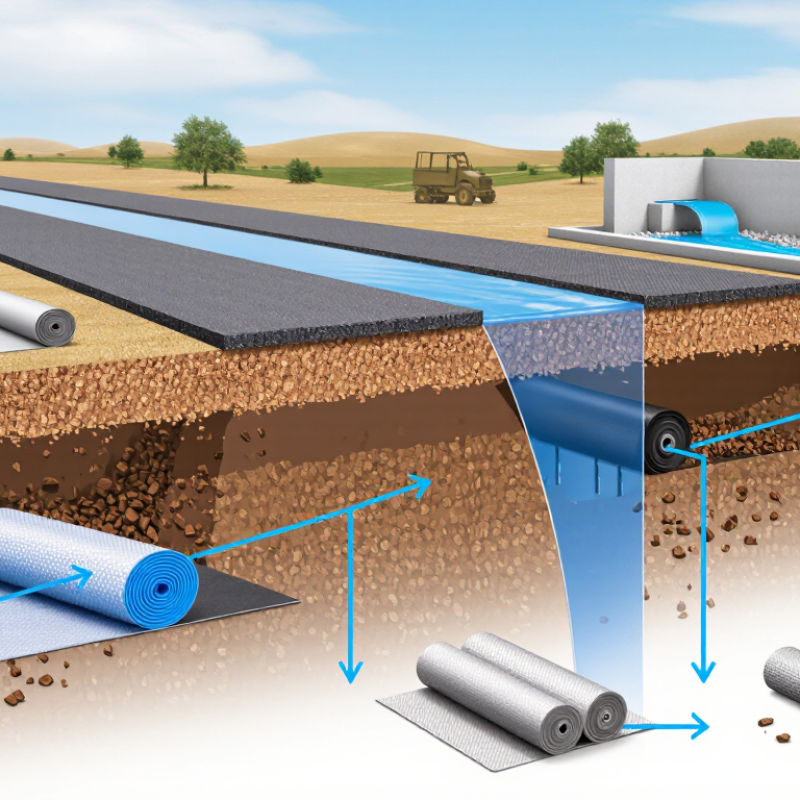
Define the Project Requirements for Composite Geotextile
Before selecting a composite geotextile, define what each layer must do on site. Is the project separating soft subgrade from aggregate, filtering water, or draining it along a slope? The Federal Highway Administration’s NHI-07-092 guidance identifies five geosynthetic functions: separation filtration drainage reinforcement erosion control. A composite may serve more than one, but not automatically. Be specific.
Describe the soil, water, loading, and installation conditions. Fine silts need careful filtration design; a steep drainage layer faces different flow demands than a road base. FHWA guidance points designers toward measurable properties, including tensile strength, apparent opening size, and permittivity. ASTM D4751 and D4491 provide test methods for the latter two. Include expected flow rates, soil gradation, construction equipment, and exposure time in the specification. Small details matter. A strong fabric can still clog if its openings do not suit the soil. I would also question vague phrases like “heavy duty”; they sound reassuring, but they do not define a test value or project need.
Assess Site Conditions, Soil Type, and Water Flow
Choosing a composite geotextile starts with the ground, not the product sheet. The USDA NRCS Soil Survey Manual defines sand particles as 0.05–2 millimeters, silt as 0.002–0.05 millimeters, and clay as smaller than 0.002 millimeters. Those sizes affect soil retention and clogging risk. A sandy trench may drain freely; silty soil can carry fine particles toward the filter. Check a representative soil sample, not just the surface. A clean sample can mislead.
Then assess water flow and installation conditions. Note where water enters, how quickly it moves, and whether flow is steady or arrives in short bursts after rain. FHWA’s Geosynthetic Design and Construction Guidelines (NHI-07-092) identify soil retention, permeability, and survivability as key design checks. Match the composite’s opening size and water-transmission capacity to the soil and expected flow. More flow is not automatically better. A filter that passes water quickly but allows fines through may undermine the soil; one that is too restrictive may build pressure. Inspect slopes, outlet locations, and sharp stones that could damage the material during placement. Recheck assumptions when field conditions differ from the plan. That happens.
How to Choose the Right Composite Geotextile?
Assess site conditions, soil type, and water flow before selecting a product.
Reading the chart: Soil texture affects how quickly water moves through the ground. These generalized infiltration-rate ranges are indicative, not design values; actual rates vary with site conditions and should be confirmed by testing. Select a composite geotextile with filtration openings suited to the soil, adequate permeability for the expected flow, and consideration for clogging risk and drainage needs.
Compare Composite Geotextile Structures and Functions
How to Choose the Right Composite Geotextile?
Compare Composite Geotextile Structures and Functions
A composite geotextile combines layers to perform different jobs. A geotextile bonded to a geonet can filter soil while carrying water along the plane. A geotextile paired with a geomembrane adds protection and separation around a low-permeability barrier. Need soil reinforcement? Look for a geogrid layer, and check its connection to the surrounding fabric. Small construction details matter.
Compare measured properties, not layer count alone. For filtration, review apparent opening size and permittivity against the site soil. For drainage, check in-plane flow capacity under the expected pressure; values measured without load may overstate field performance. FHWA’s Geosynthetic Design and Construction Guidelines (FHWA-NHI-07-092) treats filtration, drainage, separation, and reinforcement as distinct design functions. ASTM D5101’s gradient-ratio test is also useful for soil–geotextile compatibility; a ratio below 3 is a common screening criterion, not a universal guarantee. Check the project specification. I still pause over “all-in-one” claims: layers can interact, and installation damage or clogging can undermine a promising laboratory result. Ask for test conditions, including soil type, normal pressure, and flow direction, before comparing reports.
Check Performance Standards and Material Compatibility
Choosing a composite geotextile starts with the job it must perform: separate soil, filter water, reinforce a weak layer, or protect a barrier. Check each function against the project specification, then review test results for the complete assembly. AASHTO M 288-17 lists a minimum permittivity of 0.05 s⁻¹ for several geotextile classes; the correct class depends on the application. Do not treat that value as a universal target. ASTM D4491 measures permittivity, D4751 measures apparent opening size, and D4595 evaluates wide-width tensile strength. Compare results tested using the same methods and units.
Material compatibility matters just as much. A fine soil may clog an unsuitable filter fabric, while an overly open fabric can allow particles to escape. Check the fabric’s opening size against the soil gradation, and confirm that water can pass through the fabric and drainage core together. Small mismatch. Big consequences. Also review chemical exposure, temperature, installation abrasion, and how layers are bonded; a strong component can still fail as part of a poorly matched composite. Request test reports that identify specimen construction and conditioning, not just headline values. I would want to see project-specific checks too: lab numbers cannot fully reproduce soil variability or a rough installation. Revisit assumptions when site conditions differ.
Select for Installation Needs and Long-Term Durability
Choosing a composite geotextile starts with the installation conditions, not a catalogue description. Identify what the layer must do: separate soil, filter water, reinforce a weak subgrade, or protect a geomembrane. A drainage composite needs a reliable flow path under expected pressure. A protective layer must resist punctures from angular stones and construction traffic. Check tensile strength, puncture resistance, permeability, and compatibility with nearby materials. I would not choose by weight alone. It can be a useful clue, but it does not tell the whole story.
The ground matters. Soft, uneven soil may need careful preparation and a tougher protective layer; sharp debris can damage a product before it is covered. Plan overlaps and seams around the crew’s working space, wind exposure, and equipment access. Small details count. Keep rolls covered during storage, avoid dragging them over rough ground, and inspect seams before burial. For long-term durability, consider expected loads, water chemistry, temperature changes, and exposure to sunlight during installation. Ask for test data tied to the project conditions, rather than relying on broad claims. One limitation is easy to overlook: even a strong composite cannot compensate for poor drainage design or careless placement. Revisit the specification with the installer before ordering.
| Project Need | Common Composite Structure | Key Selection Priorities | Installation Considerations | Long-Term Durability Checks | Useful Verification Data |
|---|---|---|---|---|---|
| Roads and working platforms over weak subgrade | Geotextile bonded or attached to a geogrid | Separation, filtration, and reinforcement appropriate to the soil and design loads | Check roll width, overlap or connection details, and resistance to damage from aggregate placement and compaction. | Confirm polymer suitability for expected exposure, soil chemistry, and design life; limit prolonged UV exposure before covering. | Geotextile tensile and puncture properties; geogrid tensile strength and junction performance; opening size and permittivity where filtration is required. |
| Retaining walls, steep slopes, and drainage zones | Geotextile filter bonded to a geonet or drainage core | In-plane flow capacity under the expected normal pressure, plus soil retention and filter compatibility | Orient the drainage core as designed; protect it from crushing, contamination, and damage during backfilling. | Assess creep or compression of the core, chemical compatibility, and the effects of sustained load on drainage capacity. | Transmissivity under stated normal stress and gradient; geotextile permittivity and apparent opening size; core thickness under load. |
| Landfill or containment liner protection | One or more protective geotextile layers used with a geomembrane system | Resistance to puncture and abrasion, compatibility with the liner, and protection under the specified cover material | Prepare a smooth subgrade, avoid dragging rolls over the liner, and follow project requirements for seams, overlaps, and placement. | Verify chemical resistance and confirm that sustained overburden pressure will not compromise protection. | Mass per unit area, puncture resistance, tensile properties, polymer type, and project-specific interface or protection testing. |
| Drainage behind foundations or below slabs | Geotextile filter combined with a drainage core or geonet | Reliable water flow, soil retention, and suitable discharge connections | Keep the filter face in contact with the soil as specified; protect outlets from blockage and ensure continuity between panels. | Consider clogging potential, soil chemistry, biological growth where relevant, and compressive behavior over the service period. | Transmissivity under expected load; filter compatibility assessment; compressive strength and flow capacity after installation-related reductions. |
| Railway track beds and heavily trafficked granular layers | Geotextile combined with a reinforcing grid or other stabilizing element | Separation, filtration, and load-related reinforcement suited to the ballast or subbase design | Account for ballast angularity, construction traffic, overlaps, and the required placement sequence. | Check resistance to installation damage and environmental exposure, and ensure long-term soil retention and drainage needs are met. | Installation damage resistance, tensile properties, puncture resistance, opening size, and hydraulic properties appropriate to the soil. |
| General selection and specification | Choose the composite configuration to match the primary function: separation, filtration, drainage, protection, or reinforcement. | Base selection on site soil, hydraulic conditions, loads, exposure, design life, and applicable project standards. | Review roll handling, seam or overlap details, subgrade preparation, cover placement, and construction quality controls. | Use design values that account for relevant reduction factors, including installation damage, creep, and chemical or biological exposure where applicable. | Request test methods, declared values, quality-control data, and performance results at representative stresses and conditions. |
| Note: Composite geotextile properties vary by product construction and test method. The information above is a selection guide, not a substitute for project-specific design, soil-filter compatibility analysis, or verified manufacturer test data. | |||||
FAQS
It combines layers for jobs such as filtration, drainage, separation, reinforcement, or barrier protection. A fabric bonded to a drainage core can filter soil and carry water sideways.
Compare measured properties, not just the number of layers. Check opening size, water flow, strength, and test conditions. Pressure matters.
Compare its opening size with the soil gradation. An overly tight fabric may clog; an overly open one may let particles escape. Small mismatch. Big consequences.
Ask for in-plane flow capacity under expected pressure. Unloaded test results may overstate performance in the ground. Confirm the test’s flow direction, too.
Review water-flow capacity, apparent opening size, tensile strength, and puncture resistance. Compare results only when test methods and units match.
No. It is a common screening value for soil–fabric compatibility, not a universal guarantee. Check project requirements and site soil.
Prepare uneven ground and remove sharp debris. Plan overlaps around crew access and equipment. Keep rolls covered, and inspect seams before burial.
Consider pressure, water chemistry, temperature changes, sunlight exposure, and nearby materials. Weight alone is not enough. I would still question broad claims without project-specific test data.
No. A strong layer cannot make up for poor drainage planning or careless placement. Recheck the specification with the installer before ordering.
Conclusion
Choosing the right Composite Geotextile begins with a clear understanding of the project’s purpose, such as separation, filtration, drainage, or reinforcement. Define the required performance and expected service life, then assess site conditions, including soil type, groundwater levels, water flow, and exposure to environmental stresses. These factors help determine which material structure and combination of functions best suit the application.
Before selecting a product, compare its performance specifications with the project requirements and confirm that its materials are compatible with the surrounding soil and other construction components. Consider practical installation needs, including handling, placement, and joining, as well as resistance to damage during construction. A well-matched Composite Geotextile can support reliable site performance when its design, installation, and durability are considered together.

Blog Tags: