
High-Performance Geocell & Water Management Modules
Engineered for steep slope retention, subsurface dewatering, and rapid load support across urbanizing cantons including Luxembourg City, Esch-sur-Alzette, and Clervaux.



Luxembourg's Civil Engineering & Infrastructure Realities
Addressing the complex geological topography of the Gutland and Oesling regions under strict Administration des Ponts et Chaussées environmental standards.
Ardennes (Oesling) Slope Stabilization
The northern cantons feature deeply carved valleys with weathered schist and phyllite bedrock. High-load polymeric cellular confinement stabilizes rail cuttings along the CFL network, drastically mitigating rockfalls and embankment slippage without massive concrete walls.
Gutland Sedimentary Foundation Support
The southern plateau exhibits marls, sandstones, and variable cohesive soils. Industrial developments near Bettembourg multimodal terminals require geocells to bridge low California Bearing Ratio (CBR) soils, preventing differential settlement across heavy logistics platforms.
Strict Water Protection Directives
Under Luxembourg's strict Water Management Agency (Administration de la gestion de l'eau) framework, construction within river basins (such as the Alzette and Moselle) requires non-leaching, virgin HDPE geocells that promote natural vegetative permeability while preventing sediment runoff.
3D Confinement Mechanics vs Traditional Solutions
Why Tier-1 European contractors favor geocell systems over mass gravity retainment and deep foundation piling.
| Performance Characteristic | High-Modulus HDPE Geocells | Reinforced Concrete Wall | Unreinforced Aggregate Layers |
|---|---|---|---|
| Load Distribution Mechanism | 3D hoop stress confinement converting vertical loads to horizontal thrust vectors | Rigid cantilever moment resistance prone to cracking under uneven settlement | Direct point-load dispersion with high internal shear failure risk |
| Embodied Carbon Footprint | Up to 70% CO2 reduction via aggregate optimization & local infill | Excessive embodied carbon due to clinker cement & rebar extraction | High transport emissions due to substantial quarried aggregate needs |
| Hydraulic Permeability | Perforated walls allow transverse hydraulic relief, zero pore pressure buildup | Requires artificial weeping drains; susceptible to catastrophic hydrostatic surcharge | Prone to internal suffosion, piping, and long-term subgrade clogging |
| Installation Velocity | Foldable rolls deployed rapidly without heavy cranes or formwork setting | Protracted curing periods, forms assembly, and mandatory structural inspections | Multiple layer compaction passes needed; high sensitivity to weather delays |
Localized Support & Technical Compliance Protocols
Guaranteed supply line fidelity with complete documentary traceability conforming to Luxembourgish and European standards.
Eurocode 7 & CE Marking Verification
Every lot supplied into Luxembourg conforms to EN 13249 through EN 13257 geodistribution specifications. Detailed Factory Production Control (FPC) certificates and 3.1 inspection documents confirm seam tensile strength and environmental stress crack resistance (ESCR ASTM D1693).
Multimodal Logistics to Bettembourg Hub
Our direct export workflow connects factory production directly with Luxembourgish freight platforms via Rotterdam, Antwerp, or Zeebrugge ports, minimizing customs delays with pre-cleared TARIC documentation and palletized packaging configured for compact container loading.
Long-Term Durability & Life Cycle Value
Formulated with virgin polyolefins and carbon black exceeding 2.0% mass content, guaranteeing UV-stability and chemical resistance across aggressive soil conditions, industrial runoff zones, and prolonged exposure regimes typical in European public works.
Integrated Geotechnical Engineering & Lining Systems
Combining heavy-gauge geomembranes, needle-punched cushion layers, and high-flow structural elements for projects throughout Luxembourg.
-

Custom Sponge City Siphonic Waterproof and Drainage Collection System Suppliers, Factory
-

-

-

-

-

China HDPE LDPE EVA LLDPE Double Color Polyethylene Earthwork Film/Geomembrane Factories, Company
-

Wholesale HDPE Earthwork Film, Construction Material HDPE Liner Geomembrane Suppliers, Factories
-
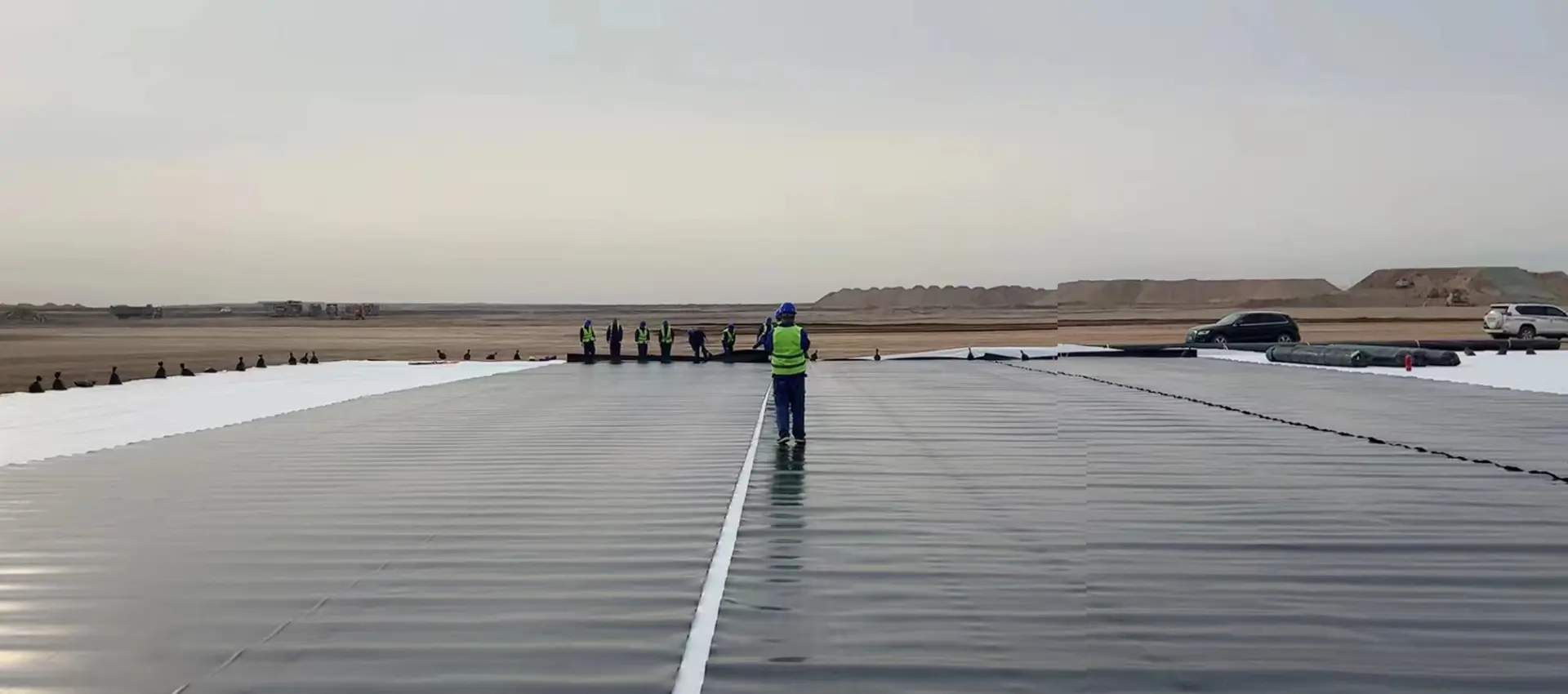
Integrated Lining & Geotextile Systems for Industrial Civil Engineering, Factories
Technological Evolution & Future Industry Outlook
Pioneering advancements designed to meet European Circular Economy goals and climate adaptation requirements.
Polymeric Nano-Composite Reinforcements
Next-generation polymeric formulations integrate localized micro-fibers, yielding higher creep resistance under sustained thermal shifts. This ensures steep-slope confinement integrity along road bridges across the Moselle river basin without dimensional relaxation over 50-year spans.
Smart Geogrid & Geocell Sensor Integration
Prototyped research combines distributed fiber optic sensing (DFOS) into geocell ribbons, providing civil engineering supervisors with real-time strain monitoring and early displacement notifications for embankments adjacent to critical high-speed rail tracks.
Low-Carbon Recycled-Fraction Blends
Aligned with the EU Circular Economy Action Plan, our advanced extrusion pipelines are formulating high-tensile hybrid polymers that incorporate certified post-industrial recycled resins without compromising seam weld durability or long-term environmental stress crack metrics.
Frequently Asked Technical & Procurement Questions
Essential guidance for civil engineers, quantity surveyors, and project directors sourcing geocells for the Luxembourg market.